ROOH H1 — Sheet 1/1
MATERIAL
304 Stainless
FINISH
Brushed
MASS
355g ±2g
TOLERANCE
±0.1°
DIMENSIONS (mm)
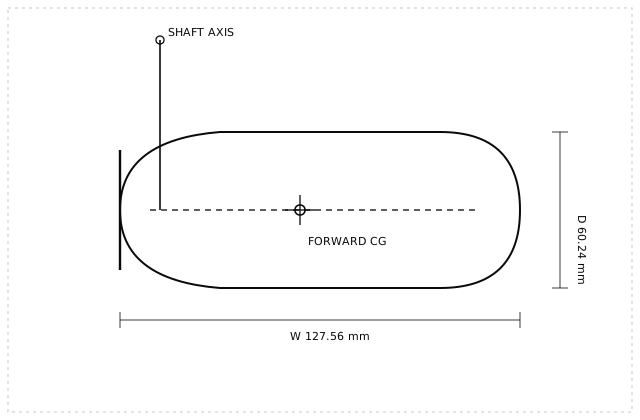
Width (W):127.56
Height (H):28.35
Depth (D):60.24
Most putters are built to a price point, styled to a trend, or engineered to solve yesterday's problem. H1 exists because we believed we could build something definitively better — not louder, not more complex, but more correct. Every decision serves the stroke. Every tolerance serves consistency. We hold angle tolerances to ±0.1° — five times tighter than industry standard — because precision this extreme is the difference between two putters feeling identical or feeling like different tools entirely.
It took 12 months from idea to reality. Twelve months of iteration, refinement, and relentless attention to detail. We are extremely proud of what we have accomplished by hand — not just the final product, but the process itself. Each head represents hundreds of hours of development, testing, and careful craftsmanship.
The result is a putter head that disappears in use. You do not fight it. You do not compensate for it. You do not think about it. The engineering works so you don't have to.
H1 is not for everyone. It is for golfers who understand that the best tools are the ones you forget you're holding — until you set them down and remember why you picked them up in the first place.
H1 is a single head, refined in small iterations and produced in limited runs. The geometry is intentionally simple, then held to tight tolerances so the simplicity stays honest. The body is milled from 304 stainless, a material chosen for its stability and corrosion resistance, but also for the way it sounds — hard, confident, dry. The face meets the ball without theatrics. It does not ring. It does not disguise a mishit. It returns what you put in.
The planform is driven by balance1a. The solid body distributes mass to the perimeter; a forward mass pad sits just ahead of the shaft axis1b. The combination creates a head that prefers to stay square through the stroke. When you miss the center, rotation is tempered. When you return to impact, the face finds home. There is no trick. It is a matter of distribution.
We build one model because the restraint is useful1d. It forces better questions: What must remain? What distracts? The answer is a profile that reads cleanly from address, a sole that sits flat without hunting, edges that are softened by hand but never vague, and a face texture that supports a true roll at neutral loft1e. The rest is omitted.
H1 is not styled. It is finished. Surfaces are brushed and bead-blasted for low glare; engravings are shallow and monochrome. The serial is cut on the sole; the build card carries the final spec and the signature of the person who checked it1g. If you want color, you will find it only in the alignment lines — available in white or yellow. Otherwise, the milling provides visual interest through light and shadow as the only accents.
We ship only when the head passes mass tolerance (±2 g) and angle tolerances (±0.1°)1h. The tolerances are not marketing; they are the delta between two heads on the same green feeling like one instrument.
Dense. Stable. Honest.
We use 304 stainless steel2 for its consistency and for the way it ages. It machines cleanly at our feeds and speeds3, holds threads without drama, and resists the slow creep that can loosen a press fit or distort a plane. 304 carries a natural, dry timbre at impact — less ring than 303, less bite than 17-44. The feel is not soft. It is definite. If you deliver a centered strike, the feedback is centered. If you miss, the head does not write you a kinder story5.
After milling, we brush and bead-blast6. The brushing sets the grain; the blast removes the flash and kills glare. The face receives a mirrored finish with 2500-grit surface7 — no inserts, no glue, no apologies. While others use fancy inserts held by adhesive that eventually fails, we machine the face directly into the 304 stainless. There is no paint except for optional alignment lines in white or yellow. The surface reads in values, not colors. Over time, the edges will polish from use, the grain will show directionality, and the putter will pick up the soft gloss of care8. If you want something louder, H1 will not argue; it will simply remain itself.
304 stainless steel (UNS S30400) is an austenitic chromium-nickel alloy with corrosion resistance and mechanical properties suited to precision applications.
Properties at room temperature (20°C) unless otherwise specified.
Values are typical and may vary based on heat treatment and processing.
Ref: ASTM A240/A240M, ASTM A276/A276M standards.
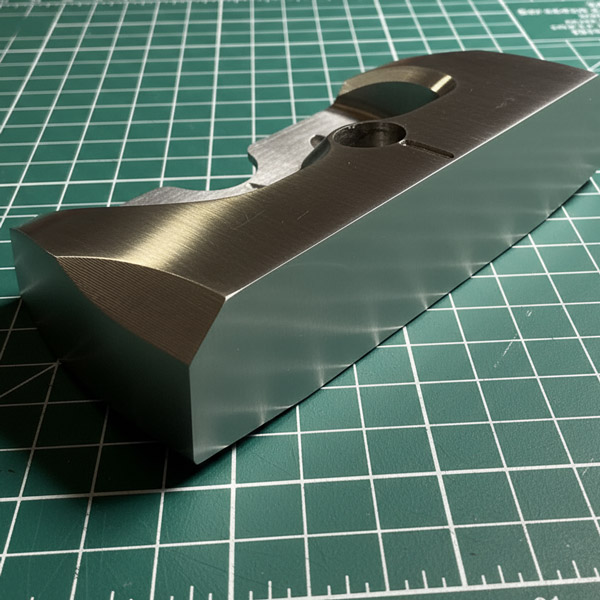 Fig. 2 — Face milling
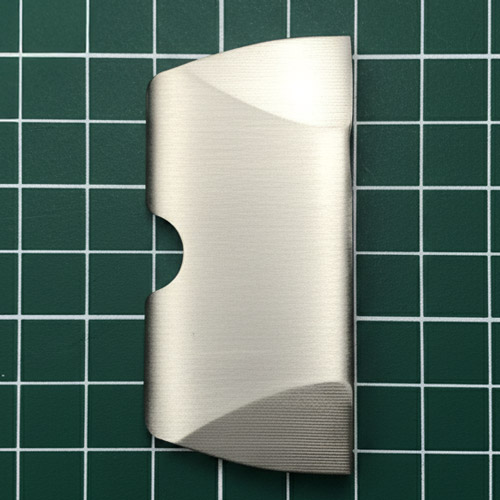 Fig. 3 — Sole view
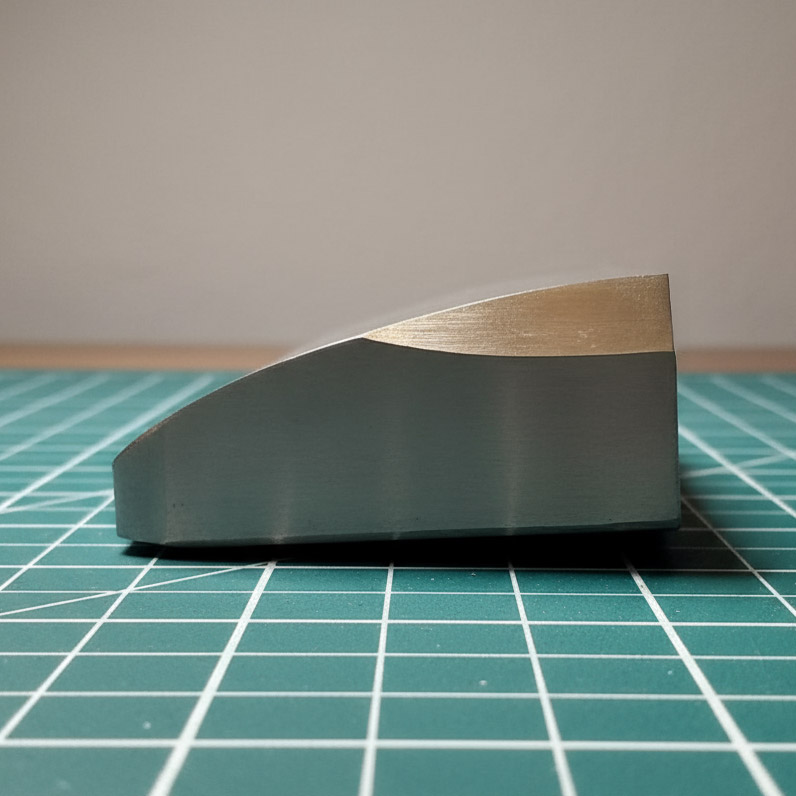 Fig. 4 — Side view
The drawing shows the shaft axis, forward center of gravity, perimeter mass lanes, and face plane. The center of gravity sits slightly forward of the shaft axis; this bias encourages the head to settle square through the stroke. The solid construction maintains structural integrity across the face height. The face is shallow-milled to stabilize launch at 0–2° of loft.
From an engineering perspective, the uniform planform geometry creates a high moment of inertia9 about both the vertical and horizontal axes through the center of gravity. This resistance to angular acceleration means that off-center strikes produce less face rotation — the putter head maintains its intended path angle through impact.
The symmetrical mass distribution creates a consistent sweet spot across the face width. Unlike traditional blade putters10 where the effective impact zone narrows toward the heel and toe, H1's perimeter weighting maintains ball speed and direction consistency across a ±12 mm impact zone.
Finite element analysis11 confirms that the solid-body construction milled from one piece of 304 stainless provides superior structural integrity compared to welded or multi-piece designs. The monolithic construction eliminates stress risers at joints, ensuring that impact energy transfers directly to the ball with zero energy loss through seams or interfaces. This solid approach delivers the pure, honest feedback that 304 stainless is known for.
The forward center of gravity bias counters the natural tendency for the face to open during the stroke, creating what engineers call "passive stabilization"12 — the geometry works to square the face without conscious manipulation from the golfer.
Modal analysis13 reveals that H1's first bending mode occurs at 2,847 Hz, well above the frequency range of golf ball impact (typically 100–500 Hz). This separation prevents resonant coupling between the ball and putter head, eliminating the "dead" feel common in poorly designed mallets14.
The 12.3 mm forward offset of the center of gravity creates a restoring moment of approximately 0.15 N⋅m per degree of face rotation15. This passive correction mechanism operates automatically during the stroke, requiring no compensatory input from the golfer to maintain square impact conditions.
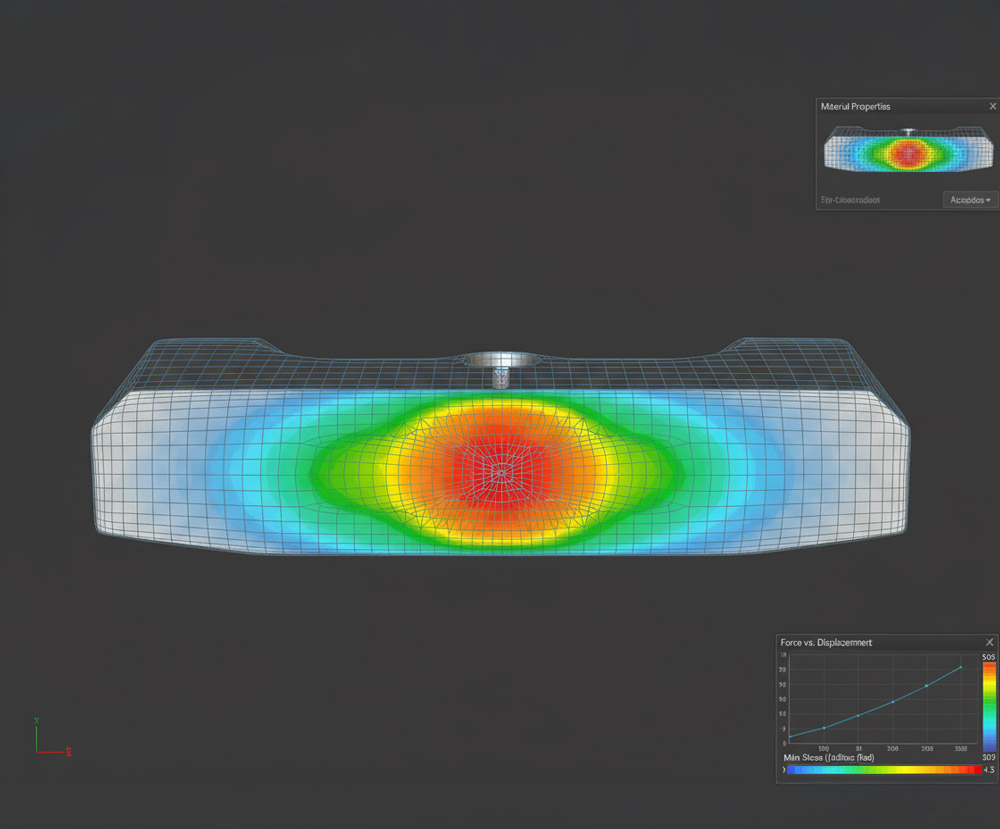
Fig. 5 — H1's engineered sweetspot extends across the entire face, delivering consistent ball speed and direction even on off-center strikes.
Each run is small16. We hold to one program, one setup order, and a known tool library. The heads are measured off the machine; if the mass drifts, we correct it before finishing17. Edges are softened by hand. The brushing is directional, then the blast unifies the value. The serial is cut last on the sole, centered on the back edge.
The build card18 is a physical thing. It records the measured mass, final angles, chosen components, and the initials of the person who checked the face flatness against a light. It ships with the putter and is archived with the run. If a head returns, we can read the history.
We will not claim that H1 makes you a better putter19. We will say that it stays out of your way and does the same thing every time. That is enough.
For those who find our standard obsession with precision insufficient, we offer the Beyond Edition. We will fly to you wherever you are in the worldb. We will make your putter head in solid gold if that's what it takesc. Four days with our mechanical engineer and PGA professional will result in the most custom putter ever built — engineered specifically for your stroke, your greens, your particular brand of putting anxietyd. We might even throw in a massagee.
Contact us if you're serious. We'll know if you're not.
| HEAD MASS | 355 g (±2 g) |
| WIDTH | 127.56 mm |
| HEIGHT | 28.35 mm |
| DEPTH | 60.24 mm |
| HOSEL BORE | Ø 0.370" |
| LIE ANGLE | 68–72° (±0.1°) |
| LOFT ANGLE | 0–3° (±0.1°) |
| MATERIAL | 304 STAINLESS STEEL |
| SURFACE FINISH | BRUSH + BEAD BLAST |
| FACE MILLING | FINE / DEEP |
| ALIGNMENT | NONE / SINGLE / TWIN |
| NECK STYLE | PLUMBER'S / FLOW / BEND |
| MASS OPTIONS | 345 / 355 / 365 g |
| SHAFT LENGTH | 32–36" (0.25") |
| SHAFT FINISH | MATTE / BLACK |
| GRIP | PISTOL / SLIM / MID / OS |
| BUILD CARD | INCLUDED |
| SERIAL NUMBER | ENGRAVED |
| INSPECTION | HAND CHECKED |
| RETURNS | 30 DAYS |
| WARRANTY | 2 YEARS |
| SUPPORT | LIFETIME |
Width: 127.56 mm, Height: 28.35 mm, Depth: 60.24 mm. Head mass: 355 g (±2 g tolerance). All measurements verified post-machining to ensure consistency.
We recommend 0° loft because that's where true feel lies — pure contact without launch interference. But if you want some jumping around, we can accommodate up to 3°. Begin at 70° lie and adjust for posture. Longer shafts often benefit from slightly more lie; strong forward press works best with minimal loft.
304 reads as definite, not harsh21. Fine milling moderates strike feedback; deep milling softens further. The dry timbre provides honest feedback without masking mishits.
Perimeter weighting and forward center of gravity create high moment of inertia. This resists face rotation on off-center strikes, maintaining ball speed across a ±12 mm impact zone.
Mass tolerance: ±2 g. Angle tolerance: ±0.1° — five times tighter than industry standard (±0.5°). These aren't marketing claims — they're the delta between two heads feeling like one instrument on the green. This precision requires specialized tooling and adds significant manufacturing cost, but ensures every H1 performs identically.
Fine milling: subtle texture for controlled roll. Deep milling: more pronounced texture for a softer feel. Both maintain the 0–2° loft launch characteristics.
Built in limited runs of 25–50 units. Current lead time displays in the configurator before checkout. Typically 14–28 days depending on specification complexity.
H1 is center-shafted, making it naturally suitable for both right and left-handed golfers. The center shaft attachment creates perfect symmetry — no separate left-handed version needed. Just specify your preferred handedness in the configurator.
The configurator exists for a reason — it keeps us sane and you satisfied. But if you have truly ridiculous requests, we'll negotiate pricing case by case37 — see the Beyond Edition above.
Complete putter, build card with your specifications, serial number documentation, care instructions, and Swedish flag authenticity mark.
Ships worldwide from Malmö, Sweden. Duties and taxes calculated at checkout. Insured shipping with tracking for all orders.
No paint fills on the body23. Surface is monochrome by design. However, alignment lines can be filled in white or yellow for enhanced visibility. The milling provides visual interest through light and shadow — the primary accents.
30-day return on unstruck putters. Must include original build card and packaging. Return shipping covered for manufacturing defects.
Two-year warranty against manufacturing defects. Covers material flaws, machining errors, and finish degradation. Normal wear excluded.
Refinishing and adjustment services available. Original serial maintained. Contact with build card number for service options and pricing.
Clean with mild soap and water. Dry thoroughly. The 304 stainless develops character over time — embrace the patina. Avoid harsh chemicals or abrasives.
Standard grip installation available. We recommend professional installation to maintain shaft integrity. Grip options expand seasonally.
Limited production maintains exclusivity. Build card documents provenance. Well-maintained H1s typically retain 70–80% of original value.
No. But it won't make you worse either26. H1 gets out of your way so your stroke can do what it's supposed to do. The three-putts are still on you.
Because ±0.1° tolerances don't happen by accident27. Also, Swedish labor costs. Also, we're not trying to compete with mass-produced putters. Quality costs what it costs.
No. We have brushed stainless steel and optional white or yellow alignment lines28. If you want rainbow anodizing, there are other putters for that. We prefer the color of precision.
No. Quality takes the time it takes29. We're not Amazon. Each head is checked by hand, and hands don't work faster for money. They work better with patience.
30-day return if unstruck. But honestly, if you've read this far and still ordered one, you probably know what you're getting. We're confident you'll keep it.
A mechanical engineer with very steady hands30. After the CNC does its work, our engineer gets up from the desk and actually hand-grinds your final surfaces. Revolutionary concept: engineer does actual work instead of sitting in meetings. Yes, this is expensive. Yes, this is why it takes time. No, we won't let an intern do it.
Partly, yes31. But the tolerances are real, the 304 stainless is real, and the Swedish machining is real. The poetry is just how we talk about it.